
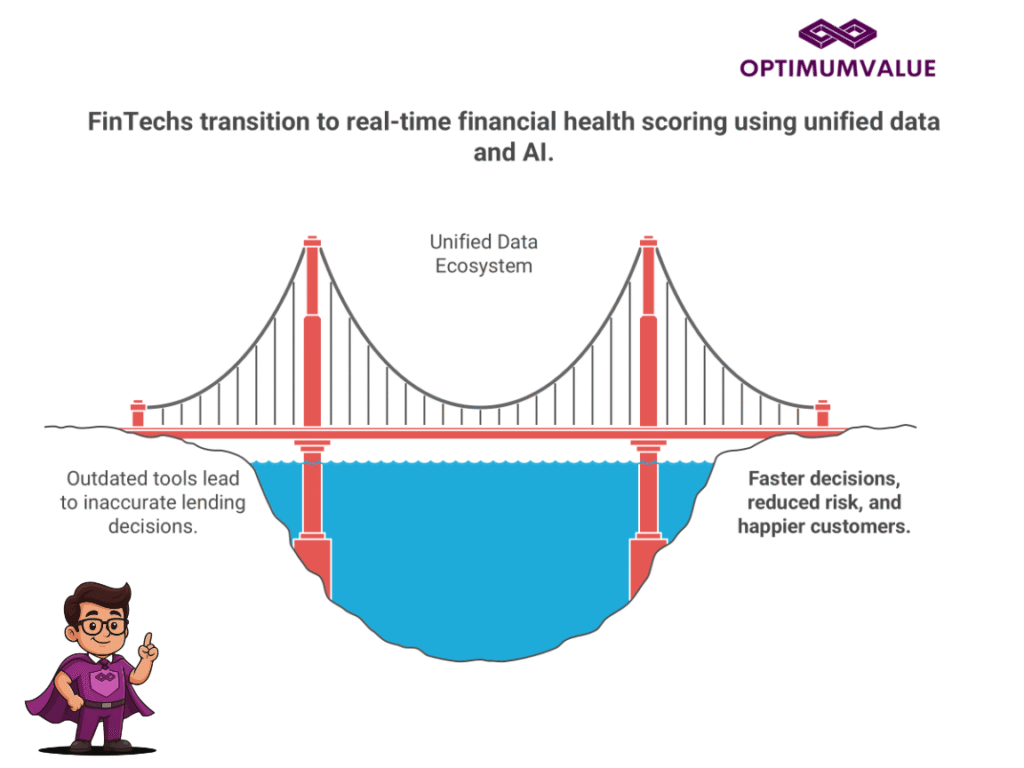
In today’s hyper-connected financial landscape, every FinTech wants to be the company that finally cracks the code on real-time borrower assessment. The promise is tantalizing: instant decisions, reduced risk, happier customers, and competitive advantage. Yet despite billions invested in AI and analytics, most financial institutions are still making lending decisions with outdated tools and fragmented data.
The problem isn’t a lack of data. With UPI processing over 640 million daily transactions in India alone, behavioral insights from CRM systems, and rich transaction histories, there’s more financial data than ever before. The real challenge is that these data streams exist in silos, like having all the pieces of a puzzle scattered across different rooms.
The Broken Promise of Traditional Credit Scoring
Traditional credit scoring feels increasingly outdated in our digital-first world. A credit bureau score based on historical data from months or years ago tells you very little about someone’s current financial health or future ability to repay.
Consider this scenario: A freelance graphic designer has an excellent payment history but took a hit during a slow quarter six months ago. Their traditional credit score reflects that rough patch, but their current UPI transactions show steady client payments, responsible spending patterns, and growing income streams. Traditional scoring systems miss this recovery entirely.
This disconnect creates two major problems:
For lenders: False positives and negatives lead to lost revenue and increased defaults. Good borrowers get rejected while risky ones slip through.
For borrowers: Qualified individuals face unnecessary friction, while others receive credit they cannot handle, leading to financial stress.
The Data Goldmine Sitting in Silos
Most FinTechs are sitting on a treasure trove of insights, but these insights are trapped in disconnected systems:
UPI Transaction Data
Every digital payment tells a story. Transaction frequency, merchant categories, timing patterns, and spending consistency provide real-time insights into income stability and financial behavior. Yet this data rarely flows into lending decisions in real-time.
CRM Behavioral Patterns
Customer relationship management systems capture how borrowers interact with financial services. Response times to notifications, app usage patterns, communication preferences, and engagement levels all signal financial stress or stability before it shows up in traditional metrics.
Income Verification Challenges
Most lenders still rely on static documents like salary slips or bank statements. But in a gig economy where income varies monthly, these snapshots provide limited insight into actual earning capacity or future stability.
The result? Lending decisions based on incomplete pictures, leading to suboptimal outcomes for everyone involved.
How Next-Generation FinTechs Are Building Real-Time Intelligence
Forward-thinking financial companies are moving beyond traditional approaches by creating unified data ecosystems that connect previously isolated information streams.
Dynamic Transaction Pattern Analysis
Instead of waiting for monthly statements, leading FinTechs analyze transaction patterns in real-time:
- Cash flow timing: Regular salary deposits vs. irregular freelance payments
- Spending categories: Essential expenses vs. discretionary purchases
- Transaction velocity: Frequency and consistency of financial activity
- Merchant analysis: Types of businesses and services being paid
This approach reveals financial health trends weeks or months before they appear in traditional credit reports.
Behavioral Risk Modeling
Advanced systems now incorporate behavioral analytics to understand customer financial habits:
- Stress indicators: Changes in app usage during financial pressure
- Communication patterns: Response rates to payment reminders and notifications
- Digital engagement: Interaction with financial education content or budgeting tools
- Social proof signals: Consistency across digital touchpoints
These behavioral signals often predict financial distress more accurately than historical payment data alone.
Real-Time Income Verification
Modern income verification goes beyond static documents:
- Live bank statement analysis: Using Account Aggregator frameworks for real-time financial data
- Pattern recognition: Identifying salary, freelance, and business income streams automatically
- Expense ratio calculations: Understanding spending patterns relative to income
- Seasonal adjustments: Recognizing and accounting for income variations
Unified Risk Scoring Architecture
The technical breakthrough comes from API-first infrastructure that creates unified data lakes ingesting information from:
- UPI transaction APIs for real-time payment data
- Account Aggregator feeds for comprehensive financial pictures
- CRM interaction logs for behavioral insights
- External data sources for additional context validation
This architecture enables real-time risk scoring that updates continuously rather than monthly or quarterly.
The Competitive Advantage of Getting It Right
Companies successfully implementing real-time financial health scoring are seeing significant benefits:
Reduced Default Rates: Real-time verification systems can reduce fraud risks by 60-80% by cross-referencing multiple data points instantly.
Faster Decision Making: Automated systems provide lending decisions in minutes rather than days, improving customer experience and operational efficiency.
Better Risk Assessment: Dynamic scoring models identify both opportunities and risks that traditional systems miss, leading to more profitable lending portfolios.
Customer Satisfaction: Borrowers appreciate quick decisions and feel understood when their current financial situation is accurately reflected in lending decisions.
Implementation Challenges and Solutions
Building real-time financial health scoring isn’t without obstacles:
Data Privacy and Compliance: Handling real-time financial data requires robust security measures and regulatory compliance. Solution: Implement privacy-by-design architectures with strong encryption and audit trails.
Integration Complexity: Connecting multiple data sources with different formats and update frequencies is technically challenging. Solution: Use standardized APIs and middleware platforms designed for financial data integration.
Model Accuracy: Real-time models must balance speed with accuracy to avoid poor lending decisions. Solution: Implement continuous learning systems that improve with each transaction and outcome.
How Salesforce Can Transform Financial Health Scoring
Salesforce’s ecosystem presents unique opportunities to address the real-time financial health scoring challenge through its comprehensive platform approach.
Customer 360 for Financial Services
Salesforce’s Customer 360 platform can serve as the unified data layer that FinTechs desperately need. By integrating UPI transaction data, CRM behavioral patterns, and income verification into a single customer view, financial institutions can finally break down the data silos that limit current scoring approaches.
The platform’s real-time processing capabilities enable instant updates to customer profiles as new financial data flows in, creating the dynamic scoring models that next-generation FinTechs require.
AI and Analytics Integration
Einstein AI can analyze the complex behavioral patterns and transaction data to identify subtle indicators of financial health that traditional models miss. The platform’s machine learning capabilities continuously improve scoring accuracy by learning from millions of customer interactions and outcomes.
Workflow Automation for Real-Time Decisions
Salesforce’s workflow automation can orchestrate the complex process of gathering data from multiple sources, running real-time risk assessments, and triggering appropriate lending decisions or follow-up actions. This automation reduces decision time from hours to minutes while maintaining accuracy.
API Integration Hub
The Salesforce integration platform can connect with UPI systems, Account Aggregator frameworks, and external data sources through standardized APIs, solving the technical complexity challenge that many FinTechs face when building real-time scoring systems.
The Path Forward
Real-time financial health scoring represents the next evolution in FinTech, but success requires more than just good intentions and advanced algorithms. It demands integrated platforms that can unify disparate data sources, process information in real-time, and continuously adapt to changing financial behaviors.
The companies that crack this code will gain significant competitive advantages through better risk assessment, faster decision-making, and improved customer experiences. Those that continue relying on fragmented systems and outdated scoring methods will find themselves increasingly obsolete in a market that demands instant, accurate, and fair financial assessments.
The technology exists today to build these systems. The question isn’t whether real-time financial health scoring will become standard, but which companies will lead the transformation and which will be left behind.