
Implementing HIPAA-Compliant Data Integrations in Salesforce Health Cloud: A Technical Deep Dive

- December 3, 2025
- 1:37 pm
- Adil Gouri
Building HIPAA-Compliant Data Integrations in Salesforce Health Cloud
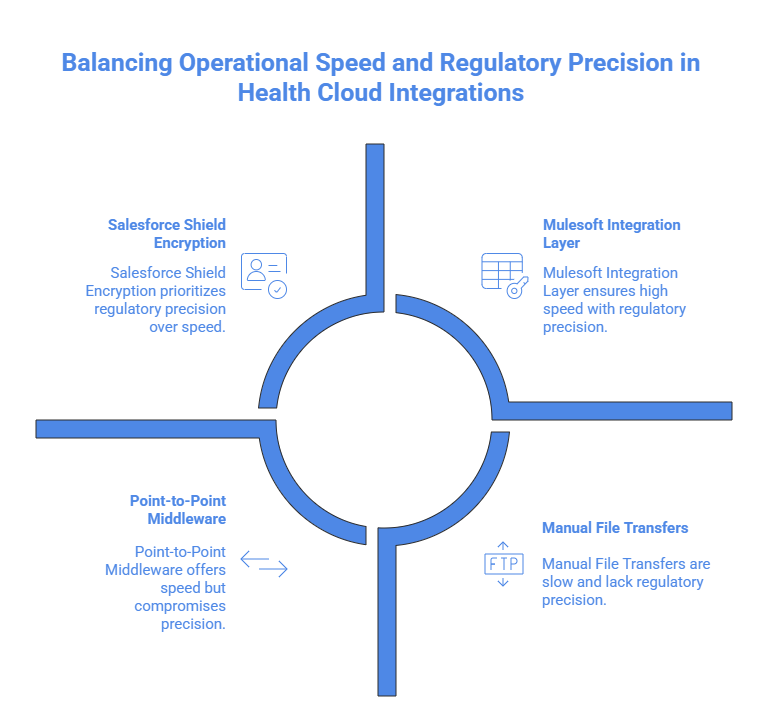
Integrating clinical data into Salesforce sounds straightforward—until you hit the real-world constraints of privacy, interoperability, and legacy healthcare systems. Every technical team wants a unified patient view, but nobody wants to be the one responsible for a compliance misstep or an unsecured integration pattern. That tension—between operational speed and regulatory precision—is exactly where most Health Cloud integration projects stall.
Healthcare organizations today are dealing with a fragmented data landscape: EHRs using different HL7 versions, payer systems operating on outdated batch pipelines, labs sending FHIR bundles inconsistently, and partner ecosystems that expect near-real-time data exchange. At the same time, the pressure for integrated care coordination has never been higher. CMS programs, value-based care models, and patient experience expectations demand more connected data flows—and faster clinical decisioning.
The challenge is that most of this data is sensitive by design. PHI sits in siloed systems with varying security postures, making it hard to move, audit, and govern. Manual file transfers, flat-file exchanges, and point-to-point middleware expose organizations to breaches, inconsistent data quality, and integration sprawl. And when Health Cloud is introduced, teams often underestimate the architectural planning required to align data models, secure endpoints, and design event-driven patterns that satisfy HIPAA’s Privacy, Security, and Breach Notification Rules.
This is where Salesforce Health Cloud provides a structured, compliant-ready foundation—but only when paired with the right integration architecture. In a technical sense, Health Cloud is designed to consume clinical and administrative data through standardized APIs, a healthcare-specific data model, and multi-layered security controls. Mulesoft adds FHIR-ready transformations, tokenized API gateways, and reusable integration patterns. Shield enhances platform encryption, event monitoring, and audit trails—critical for HIPAA compliance. And Experience Cloud can expose controlled PHI views for care teams, partners, or patients based on field-level encryption and data access rules. A HIPAA-aligned architecture isn’t a feature—it’s the combination of these layers configured intentionally.
Consider a realistic workflow: A regional hospital wants to sync patient demographics, encounter history, and lab results into Health Cloud from multiple EHR systems. Previously, their nightly SFTP batch files caused delays and created inconsistent patient profiles. After implementing a Mulesoft integration layer, each EHR sends HL7 or FHIR data to a secured API gateway, where it’s normalized, validated, encrypted, and mapped to Health Cloud objects. Salesforce Shield encrypts sensitive fields at rest, while event monitoring tracks every access to PHI. Care coordinators now see near-real-time updates, reducing duplicate outreach and improving clinical follow-ups—all without expanding compliance risk.
Once this infrastructure is in place, the benefits compound quickly. Providers gain a longitudinal patient record without maintaining redundant data stores. IT teams can scale integrations by reusing APIs rather than building custom scripts for each new system. Compliance teams get full auditability of who touched what data, when, and why. Even the patient experience improves as unified data enables faster responses, personalized care plans, and coordinated engagement across departments.
Looking ahead, healthcare data ecosystems are trending toward event-driven interoperability, AI-assisted care pathways, and predictive clinical models. Salesforce’s investments in AI, real-time data ingestion, and secure integration patterns position Health Cloud as a future-proof hub—provided organizations continue to mature their integration architectures. HIPAA compliance will only get more complex as data sources multiply; the advantage will go to organizations that build flexible, secure, API-first foundations now.
If you’re evaluating how Salesforce fits into your health data integration strategy, we help organizations validate architectural approaches, ensure HIPAA alignment, and translate Health Cloud investments into meaningful operational outcomes.
Latest Post
The AI Impact on Salesforce:…
When AI Meets the World’s #1 CRM Salesforce built its reputation on one core idea:…
How Generative AI Is Reshaping…
The CRM You Knew No Longer Exists Customer Relationship Management was built on a simple…
How AI is Transforming Salesforce…
We Are Living the AI Revolution — Inside the CRM There was a time when…