
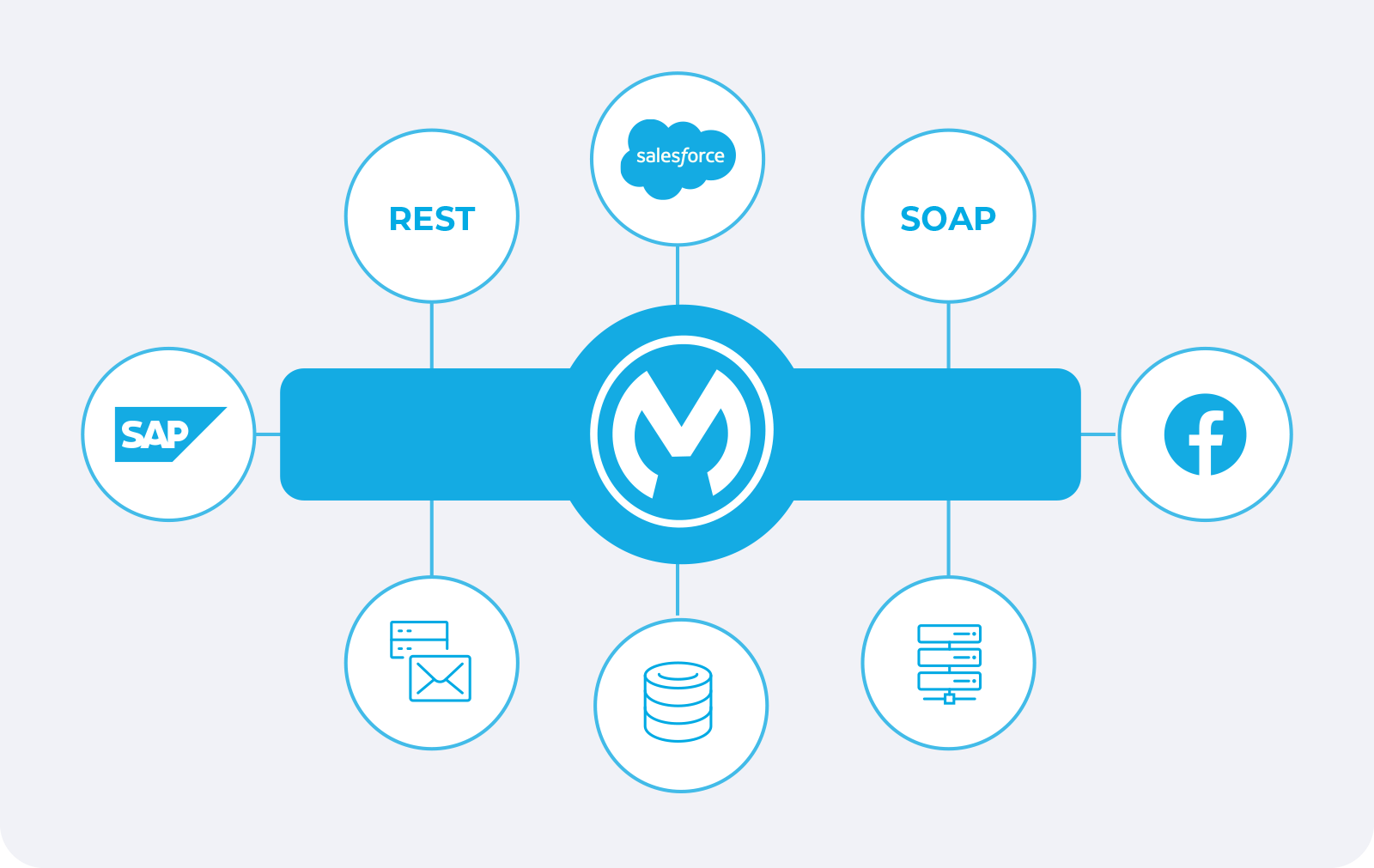
Utility providers are under pressure like never before. Aging infrastructure, rising customer expectations, and regulatory scrutiny all converge at a moment when data must move faster than the physical assets it represents. Yet most utilities still rely on decades-old CIS, billing engines, and SCADA systems that weren’t built for API-led connectivity. The tension between “modernize” and “don’t disrupt operations” is very real—and MuleSoft is increasingly becoming the quiet enabler in that balance.
Across the utility sector, organizations are pushing toward real-time grid visibility, mobile-first field operations, smart meter integration, and unified customer engagement. But the core systems running these processes are deeply entrenched. They’re stable, reliable, and mission-critical—yet notoriously resistant to integration. Replacing them is expensive and operationally risky, so leaders are shifting to a strategy that modernizes the experience layer without ripping out foundational platforms.
The core challenge is that legacy utility systems operate in silos with limited API exposure, batch-heavy data movement, and custom point-to-point integrations that break under scale. IT teams spend more time maintaining middleware patches than delivering transformation. Business teams can’t access real-time insights, customer journeys feel disjointed, and operational data becomes locked away in systems that weren’t designed to talk to each other.
This is where MuleSoft’s integration fabric plays a strategic role. Rather than forcing a system overhaul, MuleSoft enables utilities to wrap legacy platforms with modern APIs through an API-led architecture. Experience APIs support customer and field service applications, Process APIs orchestrate data between CIS, meter management, billing, and outage systems, while System APIs connect directly to legacy platforms—even if they still run on COBOL, SAP IS-U, or mainframe interfaces. The result is modernization through abstraction: new capabilities without destabilizing what already works.
Consider a utility attempting to unify outage management with customer notifications. Historically, outage data sits in OMS or SCADA, while customer communication lives in CRM. With MuleSoft, the utility exposes OMS events through System APIs, orchestrates customer matching and validation in a Process API, and feeds real-time notifications into Salesforce via an Experience API. No system replacement—just a structured integration layer that turns slow-moving data into real-time service experiences.
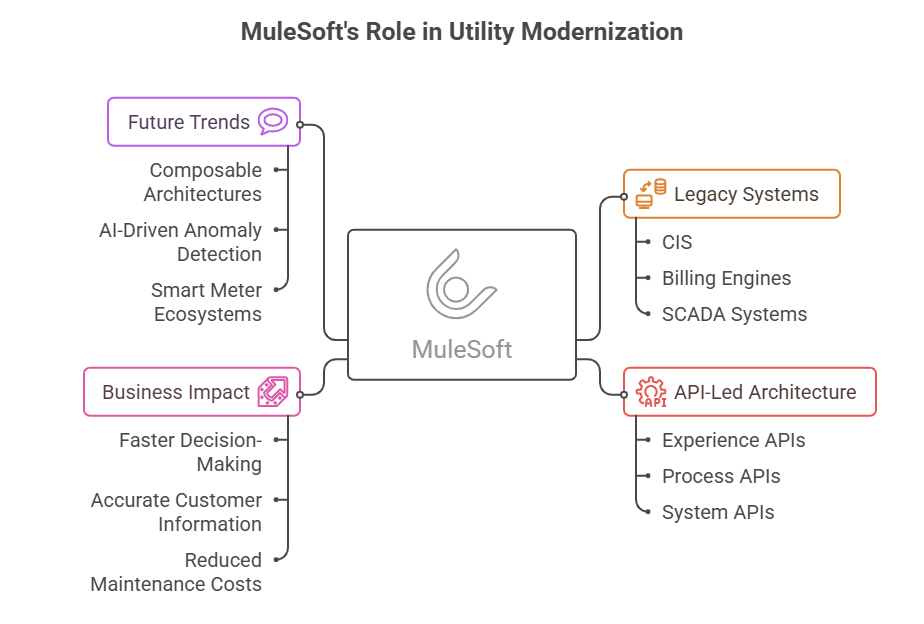
The business impact becomes visible quickly. Field teams gain faster decision-making capability, customer service has accurate and timely information, and the organization reduces integration maintenance costs by retiring brittle point-to-point connections. Most importantly, leadership can modernize incrementally instead of funding multi-year “big bang” replacements. This approach improves regulatory compliance, strengthens grid resilience, and accelerates digital experience rollouts without operational risk.
Looking ahead, utilities will increasingly depend on composable architectures where MuleSoft, AI-driven anomaly detection, smart meter ecosystems, and service platforms like Salesforce work together. As assets become more digital and customer expectations more immediate, APIs will be the connective tissue enabling utilities to transition from reactive operations to predictive, real-time service models.
If you’re evaluating how MuleSoft fits into your modernization roadmap, we help utilities assess integration maturity, design API-led architectures, and turn legacy constraints into scalable digital capability.