
Walk into any modern manufacturing plant and you’ll notice something subtle but undeniable: machines aren’t just getting faster—they’re getting smarter. Production lines that once relied on human intuition are now being shaped by algorithms, predictive signals, and real-time data streams. The shift isn’t about replacing people; it’s about removing the blind spots that humans, siloed systems, and legacy processes simply can’t eliminate on their own.
Across the manufacturing landscape, leaders are wrestling with rising variability, shrinking margins, and the expectation to operate like digitally mature enterprises. Every asset, operator, supplier, and customer now leaves a data trail—and competitive manufacturers are learning how to unify it. Yet despite this data abundance, many factories still operate with disconnected ERP records, tribal shop-floor knowledge, manual quality logs, and reactive maintenance cycles. The distance between “data available” and “data actionable” remains wide.
This gap becomes painfully clear on the production line. Machines stop without warning. Inventory mismatches stall output. Operators troubleshoot without full context. Engineering teams rely on spreadsheets to track defects. And leadership makes decisions based on weekly reports instead of live insights. The vision of a truly autonomous, self-optimizing production line remains out of reach—not because the technology doesn’t exist, but because the data and workflows that power it aren’t unified.
This is where Salesforce’s manufacturing capabilities are evolving rapidly—moving far beyond CRM. Platforms like Manufacturing Cloud, Einstein AI, Mulesoft, Data Cloud, and now the emerging AI-driven automation layer are forming a digital nervous system across plants. Salesforce is becoming the orchestration engine that blends machine telemetry, MES/ERP data, supplier signals, and customer demand to create autonomous loops: predictive scheduling, self-adjusting workflows, automated quality triggers, and AI-led downtime prevention. It’s a massive shift: Salesforce isn’t sitting on the edge of the factory—it’s becoming the intelligence layer that connects and optimizes it.
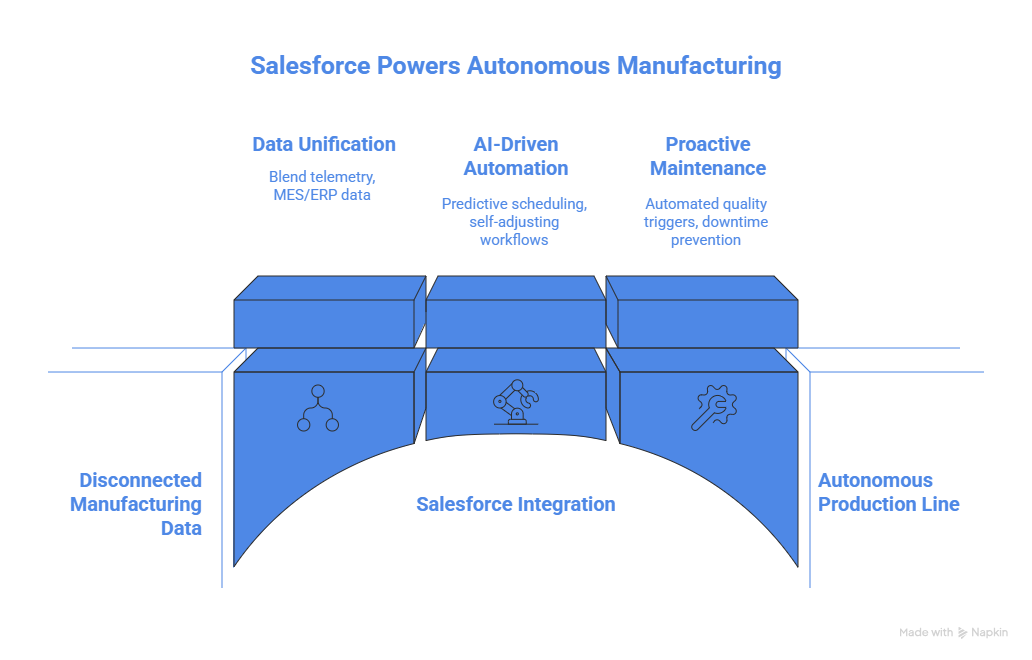
Picture a precision equipment manufacturer managing thousands of machine cycles per hour. Today, downtime is unpredictable and quality failures are caught late. After integrating MES data into Salesforce Data Cloud, machine telemetry is processed in real time. Einstein detects a vibration pattern that historically precedes a spindle failure. Before the operator even notices, a maintenance case is created, the service team receives an automated workflow, the production plan is rescheduled, and spare parts are pulled from inventory. Not a minute of output is lost. Over time, the AI model learns, adjusts, and begins making autonomous micro-corrections to eliminate variability altogether.
The operational impact is significant. Manufacturers gain consistent cycle times, fewer line stoppages, and higher yield without increasing labor load. Leaders make decisions based on unified plant performance data rather than fragmented systems. Quality issues are prevented instead of inspected. Supplier delays are anticipated instead of reacted to. Even workers benefit—less time firefighting, more time spent on value-added monitoring and improvement.
Looking ahead, AI factories will push even further toward autonomy. We’ll see production lines that negotiate their own schedules, assets that self-diagnose with near-zero false positives, and digital twins that simulate entire weeks of output before a single shift begins. Salesforce’s role will continue expanding—from CRM to the core data orchestration, workflow automation, and AI inference engine powering these autonomous ecosystems. The manufacturers that adopt this architecture early will become the ones setting global benchmarks for efficiency, sustainability, and resilience.
If you’re evaluating how Salesforce fits into your digital manufacturing roadmap, we help organizations validate approach, accelerate implementation maturity, and convert platform investments into real operational outcomes.