
Dealer Networks 2.0: How Salesforce Is Redefining Manufacturing–Dealer Collaboration

Dealer Networks 2.0: How Salesforce Is Redefining Manufacturing–Dealer Collaboration Dealer Networks 2.0: How Salesforce Is Redefining Manufacturing–Dealer Collaboration November 28, 2025 10:13 am Darpan Karanje Manufacturers are feeling a shift they can’t ignore: the dealer network model that once carried the industry is struggling to keep pace with new expectations. Dealers want faster answers. Customers want transparency. And leaders want visibility across an ecosystem that has historically operated like a collection of disconnected islands. The tension is real—and it’s pushing manufacturers to rethink how they collaborate, sell, and service through their dealer partners. Across the manufacturing sector, OEMs are modernizing product lines and investing in smart equipment, but their dealer operations often lag behind. Warranty cycles are still managed through email chains, parts orders travel through legacy portals, channel performance lives in spreadsheets, and communication with dealers depends on who picked up the phone that day. These inefficiencies aren’t just operational headaches; they’re competitive liabilities in a market where suppliers, competitors, and even disruptors are building more connected partner ecosystems. The core problem is structural: manufacturers and dealers rarely operate on a shared data foundation. Information lives in separate CRMs, dealer portals, service systems, and ERP modules that don’t speak to one another. Dealers lack visibility into OEM production timelines, warranty status, or parts availability. OEMs lack insight into pipeline, service trends, and field performance. When customer expectations hinge on real-time updates and proactive communication, this data fragmentation blocks the very collaboration the network depends on. This is where Salesforce’s latest capabilities are reshaping what “Dealer Network 2.0” looks like. Experience Cloud is becoming the backbone for modern dealer portals, unifying sales, service, training, warranty, and parts workflows. Manufacturing Cloud continues to strengthen forecasting alignment between OEMs and partners, while Service Cloud and Field Service connect dealer technicians with OEM expertise in real time. And Salesforce’s newest Einstein enhancements—predictive service insights, partner performance analytics, and AI-powered content generation—are giving both sides stronger decision-making and faster responses. The shift isn’t just digitization; it’s a new shared operational model. Consider a heavy-equipment manufacturer struggling with slow warranty turnaround. Dealers were submitting claims through multiple systems, OEM reps were manually validating documentation, and customers waited weeks for approval. By rolling out an Experience Cloud dealer portal with automated warranty workflows, embedded knowledge, and AI pre-validation, the OEM cut claim resolution from weeks to days. Dealers gained instant clarity, technicians got faster approvals, and the manufacturer finally had unified data to analyze defect patterns and supplier risks. The impact of these connected experiences extends beyond efficiency. Manufacturers reduce operational cost, improve dealer satisfaction, and unlock real-time channel visibility that was previously out of reach. Dealers gain faster access to OEM resources, easier ways to collaborate, and clearer pathways to revenue. Customers feel the downstream benefit—better communication, faster service, and consistent experiences regardless of which dealer they interact with. When the network becomes data-driven and AI-supported, the entire value chain becomes more predictable and more resilient. Looking ahead, Dealer Networks 2.0 will be defined by connected ecosystems, AI-guided workflows, and shared intelligence between OEMs and dealers. Manufacturers will increasingly rely on predictive demand models, automated parts forecasting, and AI-enhanced service diagnostics. Dealers will expect OEMs to deliver seamless digital experiences, not static portals. And Salesforce’s evolution—particularly in data cloud, process automation, and Einstein’s growing partner-focused capabilities—positions it as a central platform for enabling that transformation. If you’re evaluating how Salesforce fits into your dealer network strategy, we help manufacturers clarify their roadmap, define the right collaboration model, and activate Salesforce in ways that turn channel complexity into measurable business performance. Latest Post 27Nov BlogsUtility How Salesforce’s Renewable Energy Commitments… How Salesforce’s Renewable Energy Commitments are Reshaping Corporate Clean Power Procurement November 27, 2025 10:09… 27Nov BlogsHealthCare Leveraging AI & predictive analytics… Leveraging AI & predictive analytics to move from reactive treatment to predictive treatment November 27,… BlogsFinancial ServiceHealthCare Is the Branchless Bank the… Is the Branchless Bank the Future? How Salesforce Will Enable Fully Digital Banking by 2030…
Using Salesforce Net Zero Cloud to Track Scope 1, 2, and 3 Emissions—Even in Distributed Energy Systems
Using Salesforce Net Zero Cloud to Track Scope 1, 2, and 3 Emissions—Even in Distributed Energy Systems Using Salesforce Net Zero Cloud to Track Scope 1, 2, and 3 Emissions—Even in Distributed Energy Systems November 28, 2025 10:24 am Adil Gouri The renewable sector has never been more dynamic—or more complex. As operators scale solar farms, hybrid microgrids, and distributed energy resources (DERs), they’re also navigating something far less visible: accurate, audit-ready carbon accounting. The pressure is real. Investors want transparency, regulators want defensible data, and customers expect proof—not promises—of sustainability progress. Across the renewable industry, this is becoming the next big operational challenge. Energy portfolios are expanding, but so are data sources, reporting frameworks, and compliance expectations. DER operators in particular struggle with decentralized assets, variable generation data, third-party partners, and the growing scrutiny on Scope 3 emissions. The industry is shifting from “tracking emissions annually” to “managing emissions continuously,” and that requires technology more robust than spreadsheet-driven reporting. This is where most renewable organizations hit the wall. Emissions data is scattered across SCADA systems, IoT sensors, procurement platforms, fuel logs, supplier disclosures, and energy trading systems. Scope 1 and 2 calculations might be manageable, but Scope 3—supplier-driven, upstream, and downstream—often becomes a black box. Without a unified model, it’s nearly impossible to ensure consistency, automate baselines, or prepare for evolving global standards like GHG Protocol, CSRD, and SEC climate disclosures. Salesforce Net Zero Cloud steps in by giving renewable operators a technical foundation for emissions intelligence—not just emissions reporting. Built on the Salesforce platform, it provides a structured carbon data model, automated calculation engines, multi-framework reporting, and integration capabilities that fit naturally into distributed energy operating environments. Through APIs, Mulesoft connectors, and secure data ingestion pipelines, DER operators can pull in meter readings, fuel consumption, supplier data, and lifecycle information directly into a unified emissions ledger. The platform’s calculation models support Scope 1, 2, and 3 categories at a granular level, while leveraging audit trails, sharing rules, and row-level security to protect sensitive operational data. Consider a renewable developer managing a portfolio of solar parks alongside a network of commercial microgrid installations. Historically, emissions tracking meant manually consolidating inverter data, utility bills, diesel backup usage, O&M supplier reports, and logistics records. After implementing Net Zero Cloud, the organization connects inverter telemetry via Mulesoft, automates electricity emissions factors, and pulls supplier lifecycle data through standardized templates. The platform populates each emissions category automatically, highlights anomalies, and produces CSRD-aligned reports with a single click. What previously took weeks of manual consolidation now becomes a live emissions dashboard accessible to sustainability, finance, and compliance teams. The operational benefits compound quickly. Teams gain real-time visibility into carbon intensity across distributed assets. Audits become simpler because data lineage is built into every record. Supplier engagement improves because Scope 3 calculations follow a consistent, transparent method. Executives can finally quantify the emissions impact of expansion plans, procurement decisions, and asset upgrades. And because all this lives natively in Salesforce, organizations can tie sustainability metrics directly to revenue forecasts, project pipelines, and customer commitments. Looking ahead, emissions management will evolve from a reporting exercise into an operational control system. AI-driven forecasting, anomaly detection, automated supplier scoring, and integrated ESG performance dashboards will shape how renewable companies design and operate their energy networks. Salesforce’s expanding Net Zero Cloud capabilities—combined with Einstein, Mulesoft, and industry integrations—position it as a core system for carbon intelligence in an increasingly distributed energy future. If you’re evaluating how Net Zero Cloud fits into your sustainability tech stack, we help renewable operators validate architecture, integrate emissions data across distributed energy assets, and turn reporting requirements into strategic advantage. Latest Post 28Nov BlogsIndustry Using Salesforce Net Zero Cloud… Using Salesforce Net Zero Cloud to Track Scope 1, 2, and 3 Emissions—Even in Distributed… 27Nov BlogsUtility How Salesforce’s Renewable Energy Commitments… How Salesforce’s Renewable Energy Commitments are Reshaping Corporate Clean Power Procurement November 27, 2025 10:09… 27Nov BlogsHealthCare Leveraging AI & predictive analytics… Leveraging AI & predictive analytics to move from reactive treatment to predictive treatment November 27,…
Reimagining the Workforce: The Business Impacts of Replacing Support Staff with AI Agents in Salesforce
Reimagining the Workforce: The Business Impacts of Replacing Support Staff with AI Agents in Salesforce Reimagining the Workforce: The Business Impacts of Replacing Support Staff with AI Agents in Salesforce November 27, 2025 10:27 am Aadinath Magar Many organizations are reaching a breaking point with support workloads—ticket volumes keep rising, customer expectations are accelerating, and internal teams are stretched thin. The traditional model of scaling support by adding more people is no longer sustainable. That tension is pushing leaders to rethink the workforce entirely, and AI agents inside Salesforce are emerging as a credible, business-ready alternative to manual support staffing. Across industries, companies are feeling the same set of pressures. Support teams are managing increasingly complex cases, customers expect instant resolutions, and operational leaders are under constant pressure to reduce cost-to-serve while improving quality. Meanwhile, the rise of digital channels and self-service has dramatically expanded the surface area of support. Human-led models alone can’t keep up, and the gap between demand and capacity keeps widening. What breaks down first is consistency and speed. Manual triage slows response time; repetitive queries eat into agent productivity; knowledge is scattered across systems; and handoffs delay resolutions. Teams end up firefighting instead of improving processes, and hidden inefficiencies compound into higher operating costs. Support leaders know automation is needed—but until recently, “automation” meant simple chatbots, not true workforce transformation. Salesforce’s new wave of AI agents changes that equation. These autonomous agents can interpret customer intent, search knowledge, take action inside Salesforce, update records, resolve cases, trigger flows, and escalate only when necessary. Unlike traditional bots, they connect deeply with Salesforce data, workflows, and business logic. In a business context, this means organizations can reduce manual workload, improve accuracy, and maintain compliance while scaling support without proportional headcount increases. AI becomes not a tool—but a workforce multiplier. Consider a global retailer dealing with thousands of returns and order inquiries daily. Previously, human agents would manually verify order details, check inventory, create cases, update customer records, and initiate refunds. By deploying Salesforce AI agents, the company automated 60–70% of these repetitive steps. AI now identifies the issue, verifies eligibility, processes returns, updates systems, and communicates with customers instantly. Human agents handle only complex exceptions. The outcome isn’t just speed—it’s a more predictable and cost-efficient operating model. The benefits compound quickly. Organizations reduce cost-per-ticket, improve resolution time, and free human agents for higher-value tasks like retention or complex troubleshooting. AI-driven accuracy reduces rework, while consistent process execution ensures compliance. Leadership gains better control over operations, with predictable staffing requirements and more reliable performance reporting. When AI agents handle the repetitive and structured work, human teams can finally focus on the exceptions where human judgment truly matters. Looking ahead, AI-driven support will mature from automating tasks to orchestrating entire support ecosystems. Agents will collaborate with each other, learn from historical outcomes, predict issues before they occur, and take proactive actions across Salesforce and connected systems. As the AI workforce becomes a normalized part of business operations, companies will shift toward a model that blends human expertise with autonomous digital labor—faster, scalable, and more cost-efficient than anything possible today. If you’re exploring how AI agents fit into your operating model, we help organizations assess automation readiness, reimagine their support workforce design, and translate Salesforce AI investments into measurable business outcomes. Latest Post 28Nov BlogsUtility AI-Powered Clinical Decision Support: The… AI-Powered Clinical Decision Support: The Next Leap with Agentforce and Salesforce Healthcare November 28, 2025… 28Nov BlogsIndustry Dealer Networks 2.0: How Salesforce… Dealer Networks 2.0: How Salesforce Is Redefining Manufacturing–Dealer Collaboration Dealer Networks 2.0: How Salesforce Is… 28Nov BlogsIndustry Using Salesforce Net Zero Cloud… Using Salesforce Net Zero Cloud to Track Scope 1, 2, and 3 Emissions—Even in Distributed…
AI Factories of the Future: How Salesforce Will Enable Autonomous Production Lines
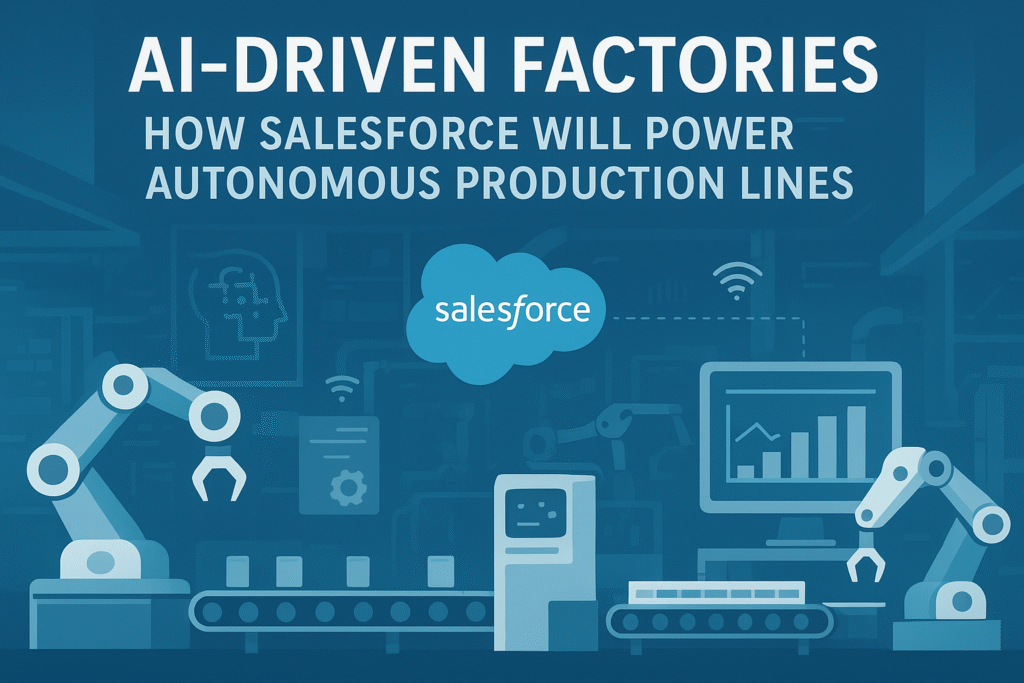
AI Factories of the Future: How Salesforce Will Enable Autonomous Production Lines AI Factories of the Future: How Salesforce Will Enable Autonomous Production Lines November 27, 2025 10:11 am Adil Gouri Walk into any modern manufacturing plant and you’ll notice something subtle but undeniable: machines aren’t just getting faster—they’re getting smarter. Production lines that once relied on human intuition are now being shaped by algorithms, predictive signals, and real-time data streams. The shift isn’t about replacing people; it’s about removing the blind spots that humans, siloed systems, and legacy processes simply can’t eliminate on their own. Across the manufacturing landscape, leaders are wrestling with rising variability, shrinking margins, and the expectation to operate like digitally mature enterprises. Every asset, operator, supplier, and customer now leaves a data trail—and competitive manufacturers are learning how to unify it. Yet despite this data abundance, many factories still operate with disconnected ERP records, tribal shop-floor knowledge, manual quality logs, and reactive maintenance cycles. The distance between “data available” and “data actionable” remains wide. This gap becomes painfully clear on the production line. Machines stop without warning. Inventory mismatches stall output. Operators troubleshoot without full context. Engineering teams rely on spreadsheets to track defects. And leadership makes decisions based on weekly reports instead of live insights. The vision of a truly autonomous, self-optimizing production line remains out of reach—not because the technology doesn’t exist, but because the data and workflows that power it aren’t unified. This is where Salesforce’s manufacturing capabilities are evolving rapidly—moving far beyond CRM. Platforms like Manufacturing Cloud, Einstein AI, Mulesoft, Data Cloud, and now the emerging AI-driven automation layer are forming a digital nervous system across plants. Salesforce is becoming the orchestration engine that blends machine telemetry, MES/ERP data, supplier signals, and customer demand to create autonomous loops: predictive scheduling, self-adjusting workflows, automated quality triggers, and AI-led downtime prevention. It’s a massive shift: Salesforce isn’t sitting on the edge of the factory—it’s becoming the intelligence layer that connects and optimizes it. Picture a precision equipment manufacturer managing thousands of machine cycles per hour. Today, downtime is unpredictable and quality failures are caught late. After integrating MES data into Salesforce Data Cloud, machine telemetry is processed in real time. Einstein detects a vibration pattern that historically precedes a spindle failure. Before the operator even notices, a maintenance case is created, the service team receives an automated workflow, the production plan is rescheduled, and spare parts are pulled from inventory. Not a minute of output is lost. Over time, the AI model learns, adjusts, and begins making autonomous micro-corrections to eliminate variability altogether. The operational impact is significant. Manufacturers gain consistent cycle times, fewer line stoppages, and higher yield without increasing labor load. Leaders make decisions based on unified plant performance data rather than fragmented systems. Quality issues are prevented instead of inspected. Supplier delays are anticipated instead of reacted to. Even workers benefit—less time firefighting, more time spent on value-added monitoring and improvement. Looking ahead, AI factories will push even further toward autonomy. We’ll see production lines that negotiate their own schedules, assets that self-diagnose with near-zero false positives, and digital twins that simulate entire weeks of output before a single shift begins. Salesforce’s role will continue expanding—from CRM to the core data orchestration, workflow automation, and AI inference engine powering these autonomous ecosystems. The manufacturers that adopt this architecture early will become the ones setting global benchmarks for efficiency, sustainability, and resilience. If you’re evaluating how Salesforce fits into your digital manufacturing roadmap, we help organizations validate approach, accelerate implementation maturity, and convert platform investments into real operational outcomes. Latest Post 28Nov BlogsUtility AI-Powered Clinical Decision Support: The… AI-Powered Clinical Decision Support: The Next Leap with Agentforce and Salesforce Healthcare November 28, 2025… 28Nov BlogsIndustry Dealer Networks 2.0: How Salesforce… Dealer Networks 2.0: How Salesforce Is Redefining Manufacturing–Dealer Collaboration Dealer Networks 2.0: How Salesforce Is… 28Nov BlogsIndustry Using Salesforce Net Zero Cloud… Using Salesforce Net Zero Cloud to Track Scope 1, 2, and 3 Emissions—Even in Distributed…
How Salesforce’s Agentforce 360 Is Redefining Enterprise AI and Automated Workflows
How Salesforce’s Agentforce 360 Is Redefining Enterprise AI and Automated Workflows How Salesforce’s Agentforce 360 Is Redefining Enterprise AI and Automated Workflows November 27, 2025 9:48 am Laxman Gore Enterprise teams aren’t struggling due to a lack of data or tools—they’re struggling because none of it works together seamlessly. Service teams jump between screens, sales teams rely on half-updated records, and operations teams fight a constant battle to keep processes consistent. That’s the gap Salesforce’s new Agentforce 360 is stepping squarely into, and it’s already shifting how organizations think about AI-driven workflows. Across industries—from banking to healthcare to manufacturing—the demand for intelligent, compliant, and context-aware automation is accelerating. Companies want AI that doesn’t just answer questions but understands business rules, reads system data, takes action across applications, and keeps human oversight where needed. Traditional AI chatbots can’t do that. Enterprise-grade agents must be process-native, deeply integrated, and secure enough for regulated environments. This is what’s reshaping the current AI transformation curve inside the enterprise stack. The problem today is fragmentation: disconnected tools, workflow silos, inconsistent data models, and AI layers that sit on top of systems rather than inside them. Most organizations end up with “shadow automation”—scripts, point AI solutions, and macros that aren’t scalable or governed. And because these automations are not tied to CRM context or core org data, quality drops, errors multiply, and compliance risks increase. Agentforce 360 changes that pattern by embedding AI agents directly into the Salesforce platform. This isn’t just a chatbot upgrade; it’s a fully native, multi-agent framework powered by Einstein 1, secure data grounding, flow orchestration, and cross-system action execution. For Salesforce updates blogs, the angle is simple: Agentforce 360 represents Salesforce’s shift from “AI assisting users” to “AI performing work on behalf of users.” It activates flows, reads records, escalates cases, updates objects, triggers actions in external systems via MuleSoft, and adheres to field-level security and org policies automatically. Enterprises now get AI that is safe, governed, and connected to real operational logic—not bolted on. A practical example is a global logistics company managing thousands of shipment issues every day. Previously, customer agents manually checked transportation records, reviewed order details, triggered refunds, emailed carriers, and updated case statuses. With Agentforce 360, an AI agent now handles the investigation end-to-end. It searches the CRM, reads shipment history, logs interactions, drafts customer updates, initiates refund flows, and files internal escalations when conditions are met—while the human agent steps in only when exceptions occur. The friction drops dramatically and so do the overall handling times. The benefits compound quickly. Teams see higher case resolution speed, fewer manual updates, cleaner data, and more consistent process execution. Leaders get visibility into automated workload distribution, compliance improves because AI follows configured rules, and employees shift from repetitive tasks to more strategic and customer-facing work. Because everything runs inside Einstein 1, organizations get a single governance layer—no scattered scripts, no untracked automations, and no AI hallucinations acting outside guardrails. Looking ahead, Agentforce 360 signals how enterprise work will mature: human-in-the-loop oversight complemented by specialized AI agents orchestrating tasks across CRM, ERP, and digital channels. As companies move toward experience ecosystems and real-time operations, these native agents will become the backbone of scalable automation. With predictive insights, natural language workflows, and cross-cloud intelligence, Salesforce is positioning AI to become an operational colleague—not just a conversational interface. If you’re exploring how Agentforce 360 fits into your AI or automation roadmap, we help organizations assess readiness, align use cases, build scalable automation layers, and ensure AI investments drive measurable business outcomes. Latest Post 28Nov BlogsUtility AI-Powered Clinical Decision Support: The… AI-Powered Clinical Decision Support: The Next Leap with Agentforce and Salesforce Healthcare November 28, 2025… 28Nov BlogsIndustry Dealer Networks 2.0: How Salesforce… Dealer Networks 2.0: How Salesforce Is Redefining Manufacturing–Dealer Collaboration Dealer Networks 2.0: How Salesforce Is… 28Nov BlogsIndustry Using Salesforce Net Zero Cloud… Using Salesforce Net Zero Cloud to Track Scope 1, 2, and 3 Emissions—Even in Distributed…