
Enterprise teams aren’t struggling due to a lack of data or tools—they’re struggling because none of it works together seamlessly. Service teams jump between screens, sales teams rely on half-updated records, and operations teams fight a constant battle to keep processes consistent. That’s the gap Salesforce’s new Agentforce 360 is stepping squarely into, and it’s already shifting how organizations think about AI-driven workflows.
Across industries—from banking to healthcare to manufacturing—the demand for intelligent, compliant, and context-aware automation is accelerating. Companies want AI that doesn’t just answer questions but understands business rules, reads system data, takes action across applications, and keeps human oversight where needed. Traditional AI chatbots can’t do that. Enterprise-grade agents must be process-native, deeply integrated, and secure enough for regulated environments. This is what’s reshaping the current AI transformation curve inside the enterprise stack.
The problem today is fragmentation: disconnected tools, workflow silos, inconsistent data models, and AI layers that sit on top of systems rather than inside them. Most organizations end up with “shadow automation”—scripts, point AI solutions, and macros that aren’t scalable or governed. And because these automations are not tied to CRM context or core org data, quality drops, errors multiply, and compliance risks increase.
Agentforce 360 changes that pattern by embedding AI agents directly into the Salesforce platform. This isn’t just a chatbot upgrade; it’s a fully native, multi-agent framework powered by Einstein 1, secure data grounding, flow orchestration, and cross-system action execution. For Salesforce updates blogs, the angle is simple: Agentforce 360 represents Salesforce’s shift from “AI assisting users” to “AI performing work on behalf of users.” It activates flows, reads records, escalates cases, updates objects, triggers actions in external systems via MuleSoft, and adheres to field-level security and org policies automatically. Enterprises now get AI that is safe, governed, and connected to real operational logic—not bolted on.
A practical example is a global logistics company managing thousands of shipment issues every day. Previously, customer agents manually checked transportation records, reviewed order details, triggered refunds, emailed carriers, and updated case statuses. With Agentforce 360, an AI agent now handles the investigation end-to-end. It searches the CRM, reads shipment history, logs interactions, drafts customer updates, initiates refund flows, and files internal escalations when conditions are met—while the human agent steps in only when exceptions occur. The friction drops dramatically and so do the overall handling times.
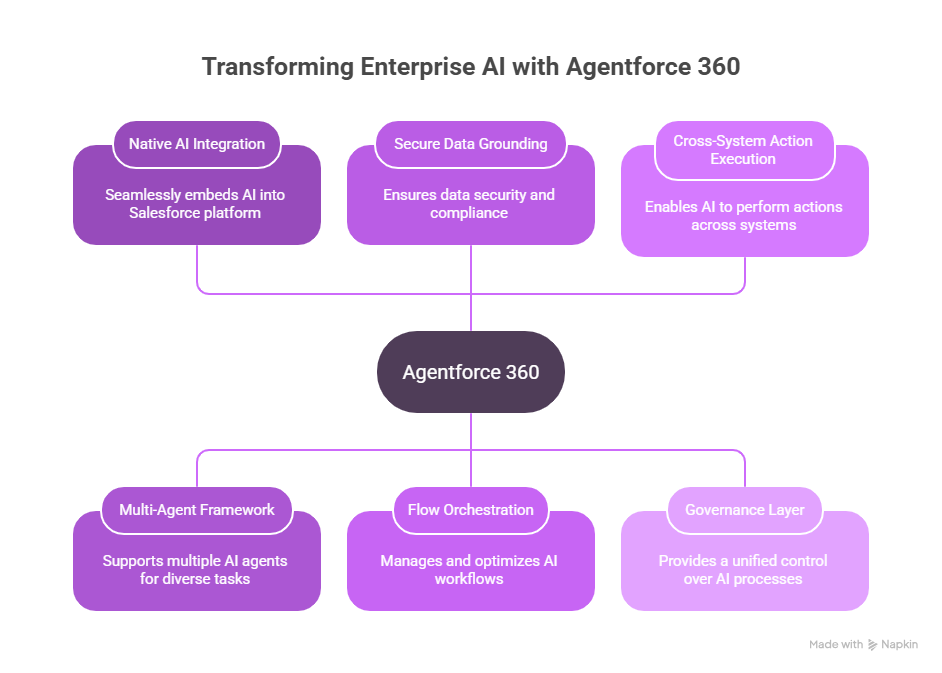
The benefits compound quickly. Teams see higher case resolution speed, fewer manual updates, cleaner data, and more consistent process execution. Leaders get visibility into automated workload distribution, compliance improves because AI follows configured rules, and employees shift from repetitive tasks to more strategic and customer-facing work. Because everything runs inside Einstein 1, organizations get a single governance layer—no scattered scripts, no untracked automations, and no AI hallucinations acting outside guardrails.
Looking ahead, Agentforce 360 signals how enterprise work will mature: human-in-the-loop oversight complemented by specialized AI agents orchestrating tasks across CRM, ERP, and digital channels. As companies move toward experience ecosystems and real-time operations, these native agents will become the backbone of scalable automation. With predictive insights, natural language workflows, and cross-cloud intelligence, Salesforce is positioning AI to become an operational colleague—not just a conversational interface.
If you’re exploring how Agentforce 360 fits into your AI or automation roadmap, we help organizations assess readiness, align use cases, build scalable automation layers, and ensure AI investments drive measurable business outcomes.