Using Salesforce Net Zero Cloud to Track Scope 1, 2, and 3 Emissions—Even in Distributed Energy Systems
Using Salesforce Net Zero Cloud to Track Scope 1, 2, and 3 Emissions—Even in Distributed Energy Systems
- November 28, 2025
- 10:24 am
- Adil Gouri
The renewable sector has never been more dynamic—or more complex. As operators scale solar farms, hybrid microgrids, and distributed energy resources (DERs), they’re also navigating something far less visible: accurate, audit-ready carbon accounting. The pressure is real. Investors want transparency, regulators want defensible data, and customers expect proof—not promises—of sustainability progress.
Across the renewable industry, this is becoming the next big operational challenge. Energy portfolios are expanding, but so are data sources, reporting frameworks, and compliance expectations. DER operators in particular struggle with decentralized assets, variable generation data, third-party partners, and the growing scrutiny on Scope 3 emissions. The industry is shifting from “tracking emissions annually” to “managing emissions continuously,” and that requires technology more robust than spreadsheet-driven reporting.
This is where most renewable organizations hit the wall. Emissions data is scattered across SCADA systems, IoT sensors, procurement platforms, fuel logs, supplier disclosures, and energy trading systems. Scope 1 and 2 calculations might be manageable, but Scope 3—supplier-driven, upstream, and downstream—often becomes a black box. Without a unified model, it’s nearly impossible to ensure consistency, automate baselines, or prepare for evolving global standards like GHG Protocol, CSRD, and SEC climate disclosures.
Salesforce Net Zero Cloud steps in by giving renewable operators a technical foundation for emissions intelligence—not just emissions reporting. Built on the Salesforce platform, it provides a structured carbon data model, automated calculation engines, multi-framework reporting, and integration capabilities that fit naturally into distributed energy operating environments. Through APIs, Mulesoft connectors, and secure data ingestion pipelines, DER operators can pull in meter readings, fuel consumption, supplier data, and lifecycle information directly into a unified emissions ledger. The platform’s calculation models support Scope 1, 2, and 3 categories at a granular level, while leveraging audit trails, sharing rules, and row-level security to protect sensitive operational data.
Consider a renewable developer managing a portfolio of solar parks alongside a network of commercial microgrid installations. Historically, emissions tracking meant manually consolidating inverter data, utility bills, diesel backup usage, O&M supplier reports, and logistics records. After implementing Net Zero Cloud, the organization connects inverter telemetry via Mulesoft, automates electricity emissions factors, and pulls supplier lifecycle data through standardized templates. The platform populates each emissions category automatically, highlights anomalies, and produces CSRD-aligned reports with a single click. What previously took weeks of manual consolidation now becomes a live emissions dashboard accessible to sustainability, finance, and compliance teams.
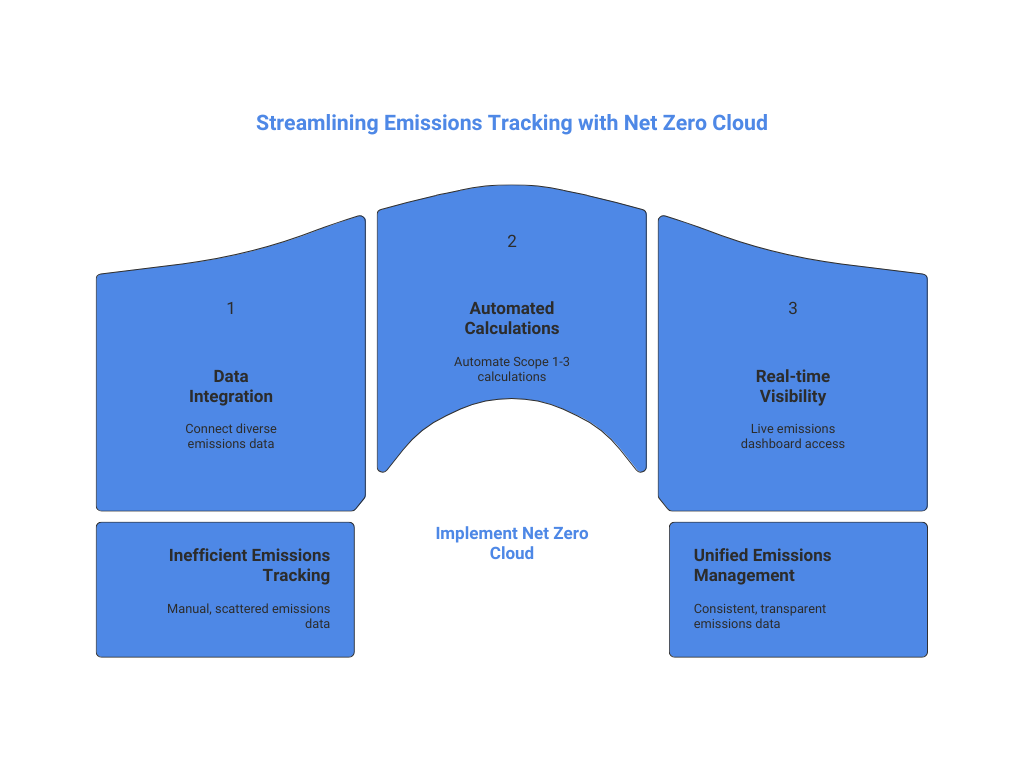
The operational benefits compound quickly. Teams gain real-time visibility into carbon intensity across distributed assets. Audits become simpler because data lineage is built into every record. Supplier engagement improves because Scope 3 calculations follow a consistent, transparent method. Executives can finally quantify the emissions impact of expansion plans, procurement decisions, and asset upgrades. And because all this lives natively in Salesforce, organizations can tie sustainability metrics directly to revenue forecasts, project pipelines, and customer commitments.
Looking ahead, emissions management will evolve from a reporting exercise into an operational control system. AI-driven forecasting, anomaly detection, automated supplier scoring, and integrated ESG performance dashboards will shape how renewable companies design and operate their energy networks. Salesforce’s expanding Net Zero Cloud capabilities—combined with Einstein, Mulesoft, and industry integrations—position it as a core system for carbon intelligence in an increasingly distributed energy future.
If you’re evaluating how Net Zero Cloud fits into your sustainability tech stack, we help renewable operators validate architecture, integrate emissions data across distributed energy assets, and turn reporting requirements into strategic advantage.
Latest Post
The AI Impact on Salesforce:…
When AI Meets the World’s #1 CRM Salesforce built its reputation on one core idea:…
How Generative AI Is Reshaping…
The CRM You Knew No Longer Exists Customer Relationship Management was built on a simple…
How AI is Transforming Salesforce…
We Are Living the AI Revolution — Inside the CRM There was a time when…