
Dealer Networks 2.0: How Salesforce Is Redefining Manufacturing–Dealer Collaboration
Dealer Networks 2.0: How Salesforce Is Redefining Manufacturing–Dealer Collaboration

- November 28, 2025
- 10:38 am
- Darpan Karanje
Manufacturers are feeling a shift they can’t ignore: the dealer network model that once carried the industry is struggling to keep pace with new expectations. Dealers want faster answers. Customers want transparency. And leaders want visibility across an ecosystem that has historically operated like a collection of disconnected islands. The tension is real—and it’s pushing manufacturers to rethink how they collaborate, sell, and service through their dealer partners.
Across the manufacturing sector, OEMs are modernizing product lines and investing in smart equipment, but their dealer operations often lag behind. Warranty cycles are still managed through email chains, parts orders travel through legacy portals, channel performance lives in spreadsheets, and communication with dealers depends on who picked up the phone that day. These inefficiencies aren’t just operational headaches; they’re competitive liabilities in a market where suppliers, competitors, and even disruptors are building more connected partner ecosystems.
The core problem is structural: manufacturers and dealers rarely operate on a shared data foundation. Information lives in separate CRMs, dealer portals, service systems, and ERP modules that don’t speak to one another. Dealers lack visibility into OEM production timelines, warranty status, or parts availability. OEMs lack insight into pipeline, service trends, and field performance. When customer expectations hinge on real-time updates and proactive communication, this data fragmentation blocks the very collaboration the network depends on.
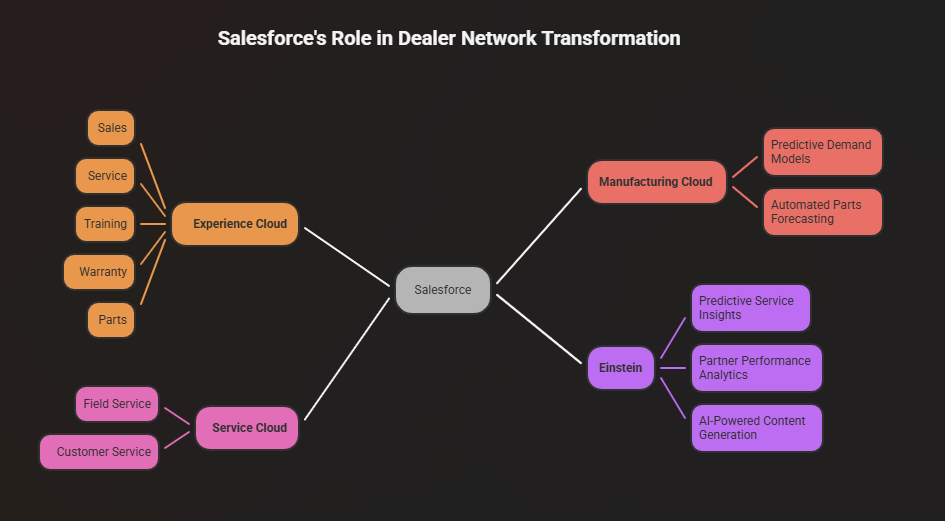
This is where Salesforce’s latest capabilities are reshaping what “Dealer Network 2.0” looks like. Experience Cloud is becoming the backbone for modern dealer portals, unifying sales, service, training, warranty, and parts workflows. Manufacturing Cloud continues to strengthen forecasting alignment between OEMs and partners, while Service Cloud and Field Service connect dealer technicians with OEM expertise in real time. And Salesforce’s newest Einstein enhancements—predictive service insights, partner performance analytics, and AI-powered content generation—are giving both sides stronger decision-making and faster responses. The shift isn’t just digitization; it’s a new shared operational model.
Consider a heavy-equipment manufacturer struggling with slow warranty turnaround. Dealers were submitting claims through multiple systems, OEM reps were manually validating documentation, and customers waited weeks for approval. By rolling out an Experience Cloud dealer portal with automated warranty workflows, embedded knowledge, and AI pre-validation, the OEM cut claim resolution from weeks to days. Dealers gained instant clarity, technicians got faster approvals, and the manufacturer finally had unified data to analyze defect patterns and supplier risks.
The impact of these connected experiences extends beyond efficiency. Manufacturers reduce operational cost, improve dealer satisfaction, and unlock real-time channel visibility that was previously out of reach. Dealers gain faster access to OEM resources, easier ways to collaborate, and clearer pathways to revenue. Customers feel the downstream benefit—better communication, faster service, and consistent experiences regardless of which dealer they interact with. When the network becomes data-driven and AI-supported, the entire value chain becomes more predictable and more resilient.
Looking ahead, Dealer Networks 2.0 will be defined by connected ecosystems, AI-guided workflows, and shared intelligence between OEMs and dealers. Manufacturers will increasingly rely on predictive demand models, automated parts forecasting, and AI-enhanced service diagnostics. Dealers will expect OEMs to deliver seamless digital experiences, not static portals. And Salesforce’s evolution—particularly in data cloud, process automation, and Einstein’s growing partner-focused capabilities—positions it as a central platform for enabling that transformation.
If you’re evaluating how Salesforce fits into your dealer network strategy, we help manufacturers clarify their roadmap, define the right collaboration model, and activate Salesforce in ways that turn channel complexity into measurable business performance.
Latest Post
The AI Impact on Salesforce:…
When AI Meets the World’s #1 CRM Salesforce built its reputation on one core idea:…
How Generative AI Is Reshaping…
The CRM You Knew No Longer Exists Customer Relationship Management was built on a simple…
How AI is Transforming Salesforce…
We Are Living the AI Revolution — Inside the CRM There was a time when…