
Most enterprise tech leaders know automation can shave hours off routine work, but what if your systems could think ahead rather than just follow instructions? The conversation is shifting — from task automation to intelligent orchestration that anticipates outcomes, adapts in real-time, and triggers action without human prompts. In an era where generative AI became table stakes, the next battleground is agentic intelligence — AI that autonomously enacts business processes and workflows that traditionally required manual oversight.
Technology companies are uniquely pressured to innovate faster, integrate complex stacks, and deliver personalized customer and employee experiences at scale. Yet many still wrestle with operational silos: CRM teams manually escalate support cases, product ops chase cross-cloud handoffs, and sales leaders juggle fragmented views of opportunity risk. Even as workflows grow in complexity, the expectation for real-time execution and insight has never been higher. This intensifies the need for systems that do more than react — systems that act.
Despite advancements in low-code automation and Einstein AI insights, a gap persists. Current automation capabilities generally require human orchestration — approvals, triggers, or monitoring to close the loop. Organizations with high-velocity operations still face bottlenecks when transforming insight into action. That’s the core challenge: connecting predictive intelligence with self-directed execution so that meaningful work doesn’t stall at the edge of human intervention.
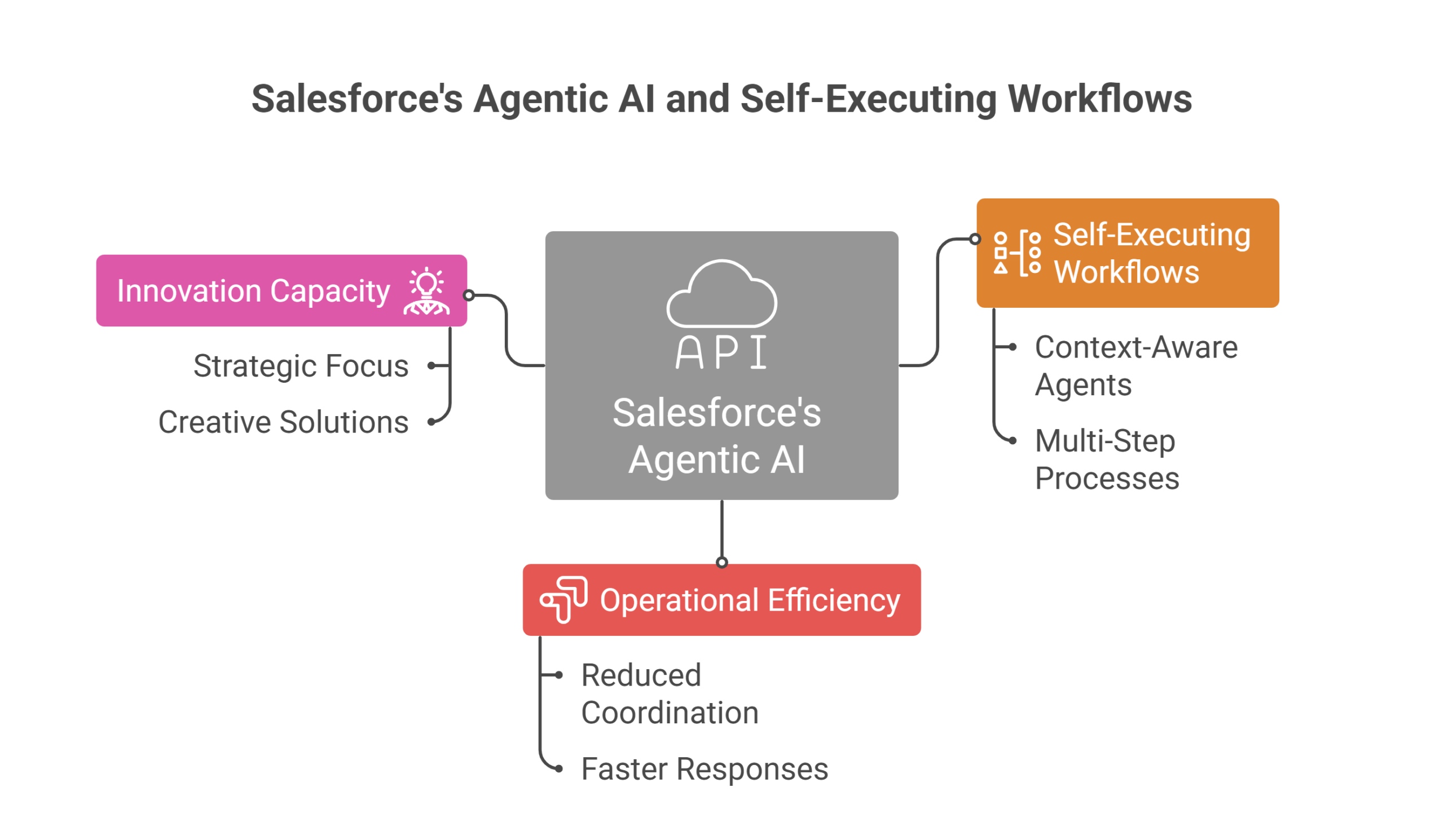
Salesforce is positioning itself at the forefront of this shift by infusing agentic AI into its platform and advancing self-executing workflows. Rather than just suggesting the next best action, agentic capabilities within Salesforce promise context-aware agents that can evaluate priorities, determine the optimal outcome, and execute multi-step processes across clouds — from automating cross-service case routing to initiating contract renewals with contextual approvals. This evolution aligns with Salesforce’s broader strategy of turning intelligence into impact rather than intelligence into recommendations alone.
Consider a tech support organization handling high-severity incidents. Today, triggers might alert a manager and create a task for review. With agentic AI and self-executing workflows, the system could automatically assess problem severity, reassign engineers, initiate customer notifications, schedule escalations, and document remediation steps — all without a single manual click. The result is a closed-loop resolution engine that learns from outcomes, improves decision paths, and accelerates time-to-resolution without burdening staff with routine governance tasks.
The benefits resonate across performance and culture. Teams waste less time on coordination, leaders gain confidence that high-priority work proceeds reliably, and customers receive faster, more consistent responses. By reducing operational friction, organizations unlock higher innovation capacity — internal talent can focus on strategy and creativity rather than chasing clicks and approvals. The measurable impact includes reduced cycle times, higher SLA compliance, and improved employee satisfaction because the system handles what it can, freeing humans for what only they should.
Looking ahead, agentic AI and self-executing workflows are more than feature buzzwords — they represent a new maturity curve in digital operations. As AI models become better at understanding context, intent, and business policies, the frontier will move toward systems that not only respond intelligently but decide and act with bounded autonomy. This evolution will challenge organizations to rethink control frameworks, governance, and trust models — demanding clarity on when and how AI should act on behalf of people and the business.
If your organization is evaluating how Salesforce’s emerging AI and automation stack fits into your tech strategy, exploring agentic capabilities and self-executing workflows now can accelerate your path to operational resilience. Aligning human expertise with autonomous execution is no longer a futuristic ideal — it’s becoming a competitive necessity.