

Clinical teams today are drowning in information yet starving for clarity. Every patient brings a complex trail of diagnostics, histories, medications, and behavioral indicators that don’t always line up neatly in an EHR. The tension between time-sensitive decision-making and fragmented clinical data has never been sharper — and it’s quietly defining patient outcomes.
Across the healthcare landscape, providers are under immense pressure to deliver precise, value-based care while navigating rising caseloads, staffing shortages, and an explosion of digital health data. Hospitals are investing heavily in interoperability, predictive analytics, and intelligent workflows, but the gap between technology and real clinical usability remains frustratingly wide. Clinical decision support (CDS) is evolving, but many solutions still operate as static-rule engines rather than dynamic, patient-aware intelligence.
The real issue isn’t a lack of data — it’s the inability to translate that data into clear, timely clinical insight. Providers often toggle between multiple systems, manually interpret unstructured notes, hunt for missing results, or rely on memory and experience to make judgment calls that should be supported by stronger data signals. With compliance frameworks tightening and personalized care expectations rising, traditional CDS tools simply can’t keep up with the speed and complexity of modern care delivery.
This is where the combination of Salesforce’s Healthcare Cloud, native FHIR integrations, and Agentforce’s autonomous AI agents is changing the architecture of clinical decision intelligence. In a technical sense, Agentforce introduces a new operational layer on top of Salesforce Health Cloud: an AI-driven orchestration engine capable of consuming medical data models, traversing clinical events, and triggering evidence-aligned recommendations. Leveraging APIs mapped to FHIR R4 resources, real-time data ingestion, event-based automations, and Einstein’s predictive models, organizations can stand up CDS agents that reason across structured and unstructured data, generate recommendations, and surface them directly inside clinician workflows. Instead of static rule triggers, you get contextual reasoning: an agent that evaluates vitals, lab values, medication contraindications, social determinants, and care pathways in one cohesive layer.
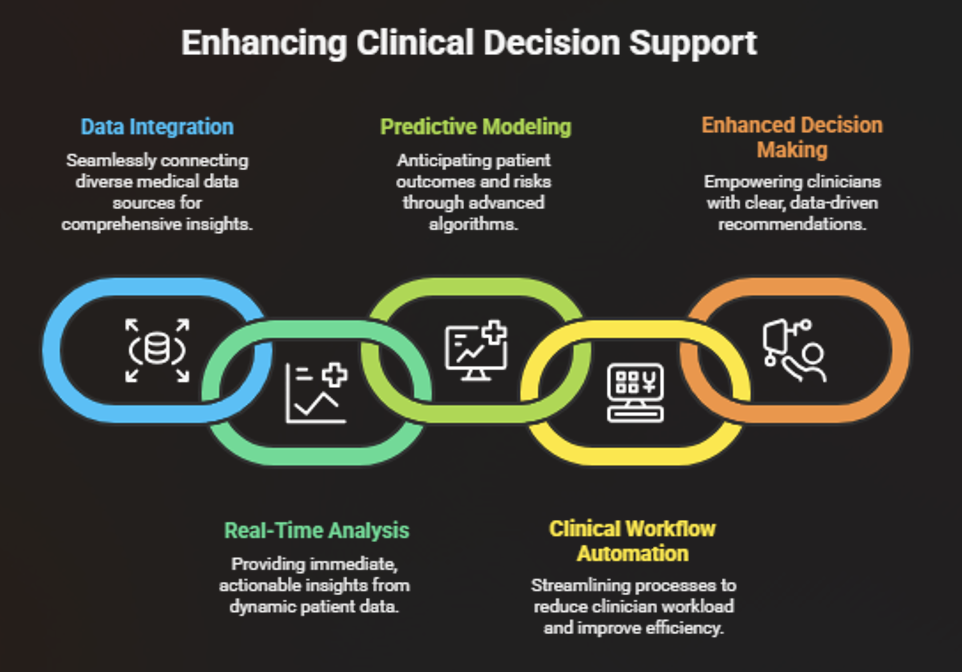
Consider how this plays out at a large integrated health system. A patient with chronic kidney disease visits the outpatient clinic with new symptoms. Historically, the clinician would sift through encounter history, labs scattered across systems, prior care plans, medication interactions, and social factors — a time-consuming process. With Salesforce and Agentforce in place, a CDS agent automatically ingests updated lab results via FHIR, compares them against established renal thresholds, evaluates medication risks, checks for gaps in the care plan, and identifies rising-risk patterns using predictive models. Before the clinician even opens the chart, the agent surfaces a concise recommendation: order a follow-up CMP, adjust medication dosage based on the patient’s GFR trend, and schedule a nephrology consult within 7 days. Friction collapses, and clinical confidence increases.
The benefits go far beyond speed. When CDS logic runs through Salesforce’s unified data model, organizations gain consistency, transparency, and auditability in how decisions are supported. Documentation becomes cleaner because AI-generated suggestions can be explained and traced. Data quality improves because agents flag missing or inconsistent clinical data before decisions are made. Most importantly, clinicians regain cognitive bandwidth — shifting from chasing information to evaluating intelligent recommendations. Operationally, this means reduced unnecessary testing, fewer preventable escalations, higher adherence to care pathways, and more predictable outcomes across populations.
Looking forward, AI-powered CDS will become less about alerts and more about continuous reasoning — a future where Agentforce agents operate as digital clinical teammates. As health systems advance their data governance and adopt more interoperable architectures, these agents will tap deeper into longitudinal patient records, genomic data, remote monitoring, and population health signals. Expect to see more explainable AI, stronger safeguards, and a move toward configurable “clinical intelligence layers” that sit on top of core EHR infrastructure. Salesforce is positioning AI not as a replacement for clinicians, but as a force multiplier that elevates clinical precision and operational reliability.
If you’re exploring how Agentforce and Salesforce Healthcare integrations can elevate your clinical decision support strategy, we help organizations design technical architectures, validate CDS use cases, and translate AI capabilities into measurable improvements in care delivery.