

The past few years have pushed telecom operators into a strange duality: scale is exploding, yet architectures are aging. Every new fiber rollout, 5G package, enterprise bundle, and IoT offering adds another layer of operational complexity—while customers expect activation to feel as simple as clicking “Buy Now.” Telcos don’t struggle because they lack systems; they struggle because those systems were never designed to keep pace with product dynamism and evolving customer journeys.
Across the telecom landscape, network modernization is happening faster than operational modernization. While 5G, fixed wireless, and converged services expand aggressively, many operators still rely on OSS/BSS stacks built around rigid workflows and point-to-point integrations that resist change. The shift toward digital-first channels, self-service experiences, partner ecosystems, and real-time provisioning is exposing the limitations of legacy order handling. Telcos need architectures that can absorb product complexity without slowing down the business.
The core issue is that traditional order management architectures simply don’t scale. Operators wrestle with deeply nested product catalogs, fragile fulfillment flows, multi-system dependencies, inconsistent quoting logic, and manual fallouts that have become “normal.” Data lives in silos—CPQ in one space, service delivery in another, network inventory somewhere else, workforce orchestration in another system entirely. When anything changes—a contract term, pricing rule, network capability—teams scramble to update five systems, often missing one. This is the operational gap keeping telcos from true digital agility.
Salesforce’s approach to telco order management is evolving quickly, and this is where the conversation becomes interesting. With the rapid improvements in Communications Cloud, Enterprise Product Catalog (EPC), Order Management, and Agentforce-powered automation, the platform is positioning itself as a unified engagement and orchestration layer rather than just a CRM. From modern product modeling and decomposed order orchestration to TM Forum-aligned APIs and near-real-time integration with provisioning systems, Salesforce is now capable of supporting much more complex telco order flows. For operators looking to migrate off monolithic BSS stacks, this architecture offers a modular, standards-based alternative that scales with new product innovation instead of slowing it down.
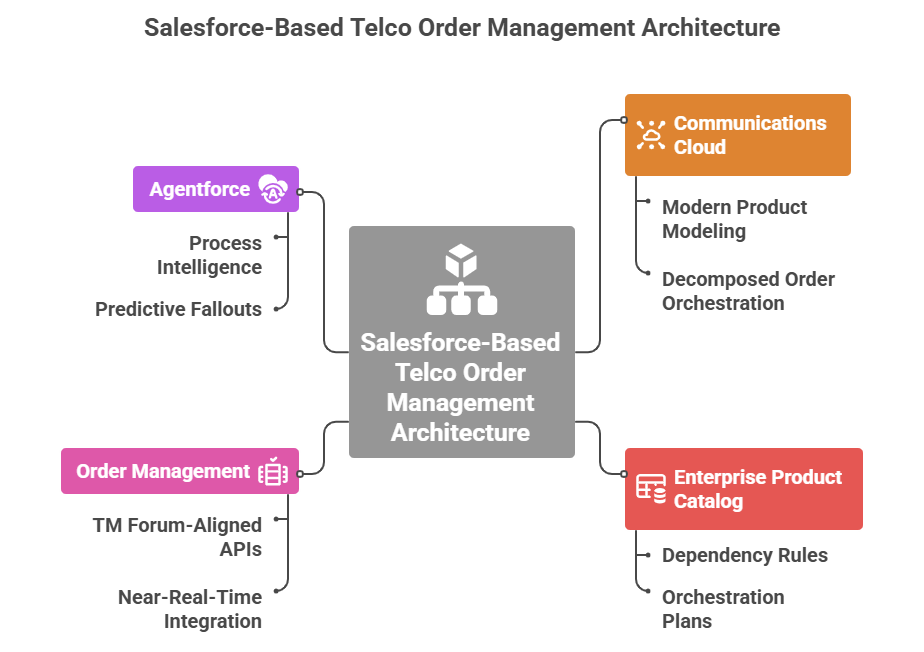
Consider a telco offering a new enterprise SD-WAN + managed security package. Historically, launching this bundle meant coordinating multiple internal teams, updating separate catalogs, and manually routing orders to different provisioning systems. Using Salesforce EPC and Order Management, the operator builds a single structured product model, defines dependency rules, and configures orchestration plans with tasks mapped to external network systems via Mulesoft APIs. When a sales team creates a quote, the order is automatically decomposed into network, security, and hardware workflows—each executed in the right sequence and monitored centrally. Fallouts, instead of becoming multi-day investigations, appear as actionable exceptions inside Service Console with AI-driven root-cause suggestions.
The benefits start compounding quickly. Product teams gain the freedom to launch complex offerings without triggering architectural chaos. Sales teams see fewer order errors because the catalog and quoting logic align. Activation cycles shorten because orchestration is standardized and API-driven. Customer service gets real-time visibility into provisioning milestones without logging into five legacy systems. And technology teams finally have an integration framework that can evolve with the network, rather than fighting against it.
What’s ahead for telco order management is clear: the industry is moving toward composable architectures, AI-assisted provisioning, and a single, ecosystem-level experience layer that spans CPQ, fulfillment, billing, and service. Salesforce is investing heavily in this direction—Agentforce for process intelligence, Einstein for predictive fallouts, a more robust EPC for complex bundles, and deeper alignment with TMF Open APIs to streamline interoperability with OSS platforms. The operators that embrace these patterns now will be better positioned for a future defined by rapid product innovation and near-zero-touch activation.
If you’re evaluating how Salesforce fits into your telco digital roadmap, we help organizations validate architecture decisions, design scalable order management patterns, and turn CRM modernization into real operational impact.