
The Challenges Financial Institutions Encounter While Implementing Salesforce Financial Services Cloud

- December 3, 2025
- 9:50 am
- Aadinath Magar
Navigating the Hidden Challenges of Implementing Salesforce Financial Services Cloud
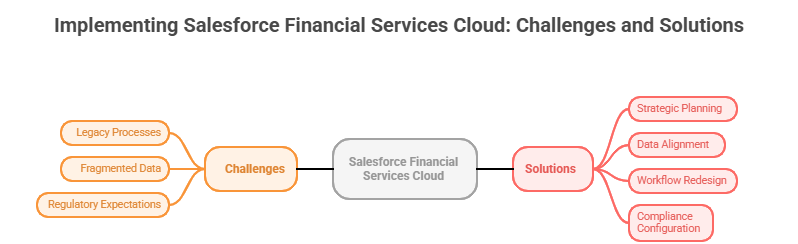
Rolling out Salesforce Financial Services Cloud (FSC) sounds straightforward on paper—centralize client data, streamline advisor workflows, strengthen compliance, and unlock more intelligent financial insights. But many financial institutions quickly realize that FSC isn’t just a system replacement; it’s a deep operational shift. The tension usually comes from juggling legacy processes, fragmented data, and strict regulatory expectations while trying to modernize customer engagement at the same time.
Across the finance industry, the pressure to deliver personalized, compliant, and high-touch experiences has intensified. Institutions are migrating away from decades-old systems and manual processes, only to find that modernization requires much more than technology. Wealth managers demand comprehensive householding views, lenders want fast and consistent credit decisioning, and compliance teams expect airtight audit trails. FSC promises this level of capability, but the road to get there often exposes gaps that financial institutions weren’t prepared for.
The core challenge is that most organizations underestimate the complexity of financial data modeling and the operational shifts required to support it. Data lives in multiple systems—core banking, loan origination, portfolio management, insurance platforms—and every department has its own version of the truth. Regulatory compliance adds another layer, requiring granular security, strict data access controls, and audit-ready logging. When all of this collides with the need for advisor productivity, omnichannel service, and seamless onboarding, cracks appear quickly.
Salesforce Financial Services Cloud helps resolve many of these obstacles, but only when institutions approach it with a strategic, challenge-focused mindset. FSC offers structured data models for households, financial accounts, and client relationships; intelligent case and goal-based planning; automated KYC/AML workflows; and flexible integration capabilities via APIs and Mulesoft. But the key to success is not simply enabling features—it’s mapping FSC’s data model to industry-specific processes, aligning advisor and operations teams on new workflows, and ensuring compliance policies are correctly configured across sharing rules, record access, and data retention requirements.
Consider a mid-size wealth advisory firm attempting to migrate from spreadsheets and a legacy CRM to FSC. Advisors are excited about the 360° client profile, but the implementation team discovers that household structures in the legacy system don’t match FSC’s data model. Compliance requires masked access to sensitive financial data, but operations teams use generic shared inboxes that violate these controls. The integration with the portfolio management system works, but the firm realizes their data quality is inconsistent—leading to mismatched balances, duplicates, and incomplete family relationships. After restructuring data, redefining advisor workflows, and tightening role-based access, the firm finally sees the benefits FSC was built for: faster onboarding, cleaner regulatory reporting, and better client conversations during reviews.
Once implemented correctly, FSC introduces measurable improvements—advisors get unified client visibility, service teams reduce manual follow-ups, executives gain clearer reporting, and compliance teams finally operate with stronger guardrails. Data that once sat trapped in disparate systems becomes actionable, enabling personalized outreach, automated next-best-action recommendations, and better segmentation for wealth, lending, and insurance offerings. These gains don’t show up overnight, but they do show up consistently for institutions that invest in proper planning, data alignment, and user adoption.
Looking ahead, the financial sector is moving rapidly toward AI-supported advisory, predictive portfolio analytics, automated underwriting decisions, and interconnected client experience ecosystems. FSC will increasingly become the digital foundation enabling these maturity leaps—but only for institutions that have built the right architectural backbone and process discipline around it. AI insight is only as good as the data, and the data is only as good as the underlying FSC implementation.
If you’re exploring Salesforce Financial Services Cloud or planning to optimize an existing implementation, we can help you assess readiness, map the right architecture, and translate FSC capabilities into real operational impact—securely, compliantly, and with advisor workflows at the center.
Latest Post
The AI Impact on Salesforce:…
When AI Meets the World’s #1 CRM Salesforce built its reputation on one core idea:…
How Generative AI Is Reshaping…
The CRM You Knew No Longer Exists Customer Relationship Management was built on a simple…
How AI is Transforming Salesforce…
We Are Living the AI Revolution — Inside the CRM There was a time when…