

Scaling Salesforce across multiple plants sounds straightforward on paper—centralize processes, unify data, and give every site a consistent operational rhythm. But anyone who has worked inside a global manufacturing environment knows the reality rarely matches the slide deck. Plants operate like self-contained ecosystems, each with its own maturity, legacy systems, and non-negotiable production constraints. When manufacturers push for standardization without understanding these nuances, friction builds fast.
Across the sector, manufacturers are under pressure to modernize while navigating supply chain volatility, talent shortages, and increasing automation across the shop floor. At the same time, every plant leader is juggling OEE targets, downtime reduction, audits, safety compliance, and shifts operating on different workflow cultures. This creates dozens of parallel operational truths—none of which neatly align with a one-size-fits-all CRM rollout.
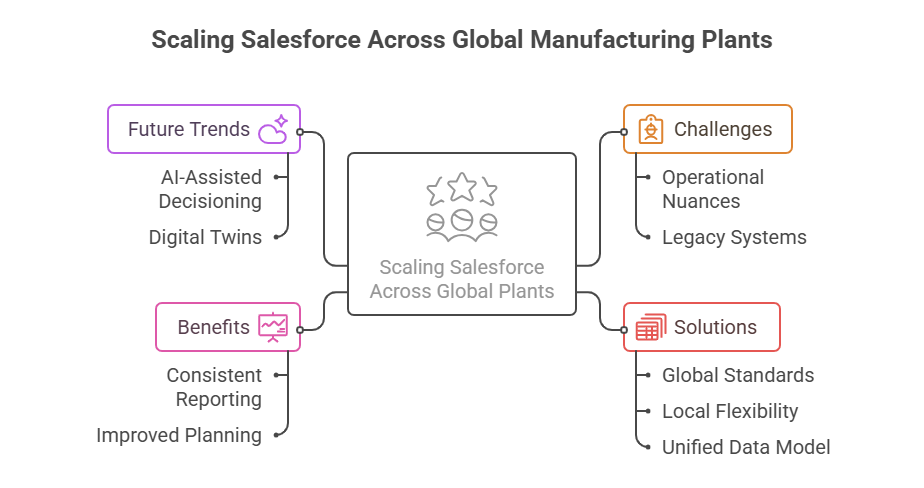
This is where scaling breaks down. Data definitions differ by region, quality processes vary, and integrations with MES/ERP systems are rarely consistent. Production teams rely heavily on tribal knowledge and local tools that have been fine-tuned for years. When Salesforce is introduced without bridging these realities, you end up with duplicate configurations, inconsistent reporting, siloed instances, and frustrated users who revert to spreadsheets because the system “doesn’t feel built for us.”
Salesforce can absolutely scale across global plants—but it requires understanding the challenge before applying the solution. For manufacturers, the platform becomes most powerful when it establishes a structured but adaptable operational model. This means defining global standards that allow for local flexibility, building a unified data model, ensuring integration patterns work across multiple ERP/MES landscapes, and using scalable components like Flow Orchestrator, Manufacturing Cloud, and Experience Cloud to drive consistent process execution without ignoring plant-level nuances. For a challenge-driven implementation like this, the emphasis is less on features and more on orchestration, governance, and adoption.
Consider a global manufacturer operating 14 plants across APAC, Europe, and North America. Each plant managed customer orders, production commitments, and quality incidents differently. When Salesforce was rolled out centrally, adoption stalled—European plants wanted more local autonomy, APAC plants relied heavily on legacy MES data, and U.S. plants demanded real-time integration with scheduling systems. Once the program introduced a tiered process model—global templates, plant-level configuration rules, and a unified integration layer—usage increased, visibility improved, and leadership finally saw comparable performance metrics across regions.
The benefits become tangible quickly. Teams gain consistent cross-plant reporting, a shared approach to managing customer commitments, standardized quality tracking, and predictable change management. Sales and operations planning becomes far more accurate when every plant works from the same data foundation. And by automating manual touchpoints, manufacturers unlock faster cycle times, fewer production surprises, and more reliable forecasting.
Looking ahead, global manufacturers adopting Salesforce will increasingly rely on AI-assisted decisioning, digital twins of plant processes, and unified experience layers for partners, distributors, and suppliers. The next wave of transformation won’t be about digitizing workflows—it will be about harmonizing operations across plants so AI can actually operate on clean, comparable data. Manufacturers that get this right now will be positioned for predictive operations instead of reactive firefighting.
If you’re evaluating how Salesforce fits into your multi-plant roadmap, we help organizations align operating models, define scalable architectures, and ensure your CRM investment delivers consistency without sacrificing plant-level realities.