
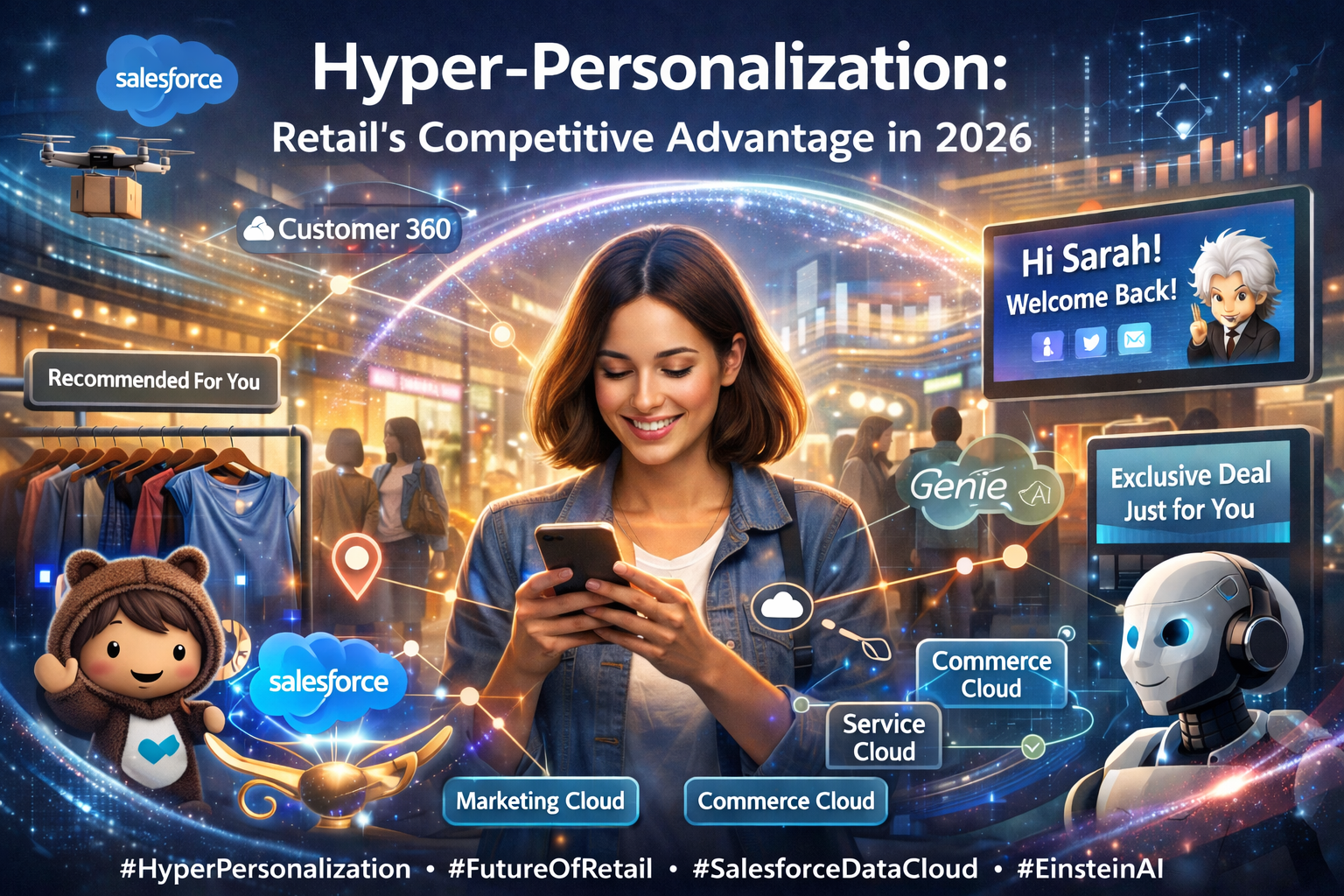
Walk into any retail brand’s ecosystem today—online or offline—and the expectation is already clear. Customers don’t want to be recognized as a segment anymore; they want to be understood as individuals. By 2026, hyper-personalization isn’t a “nice-to-have” experience layer—it’s the baseline customers silently demand, and the differentiator brands quietly compete on.
Retail is operating in an environment shaped by fragmented journeys, shrinking loyalty, and relentless comparison. Consumers move fluidly between mobile apps, stores, marketplaces, social platforms, and customer support channels. At the same time, retailers are juggling volatile demand, thin margins, rising acquisition costs, and pressure to convert first-time buyers into long-term advocates. Personalization, once driven by simple recommendation engines, now needs to work in real time, across every touchpoint.
The gap today isn’t intent—it’s execution. Many retailers still rely on disconnected systems for commerce, marketing, service, and inventory. Customer data sits in silos, campaign logic is rule-heavy, and personalization often stops at “people like you also bought.” The result is generic experiences powered by complex back-end operations that struggle to scale or adapt quickly to changing customer behavior.
This is where Salesforce’s evolution becomes strategically relevant. Salesforce is no longer just a CRM system of record; it’s becoming a system of intelligence. With Salesforce Data Cloud unifying first-party data in real time, Einstein AI interpreting behavior patterns, and tight integration across Commerce Cloud, Marketing Cloud, and Service Cloud, retailers can design experiences that adapt dynamically—without relying on brittle custom logic. Personalization moves from static campaigns to continuous, context-aware decisioning across channels.
Consider a mid-sized omnichannel retailer preparing for a peak sales season. Historically, their promotions were calendar-driven and product-focused. By centralizing customer profiles in Data Cloud and applying Einstein-driven insights, they begin tailoring offers based on browsing behavior, store visits, inventory availability, and past service interactions. A customer who abandoned a cart online doesn’t just receive a reminder email—they might see a personalized in-store offer, a relevant product bundle, or proactive service outreach if friction is detected. The experience feels natural, not engineered.
Another critical shift retailers are navigating is the balance between personalization and trust. As data volumes grow, customers are becoming more conscious of how their information is collected and used. Hyper-personalization in 2026 will only succeed when it is transparent, compliant, and value-driven. Salesforce’s emphasis on trusted AI, consent-driven data models, and governance through Data Cloud allows retailers to personalize responsibly—delivering relevance without crossing the line into intrusion.
Equally important is organizational readiness. Hyper-personalization isn’t powered by technology alone; it requires alignment between marketing, merchandising, service, and IT teams. Salesforce enables this alignment by providing a shared customer language through Customer 360, real-time insights accessible across roles, and automation that reduces dependency on manual handoffs. Retailers that invest in this operational maturity are better positioned to move faster, experiment safely, and scale personalization without adding complexity.
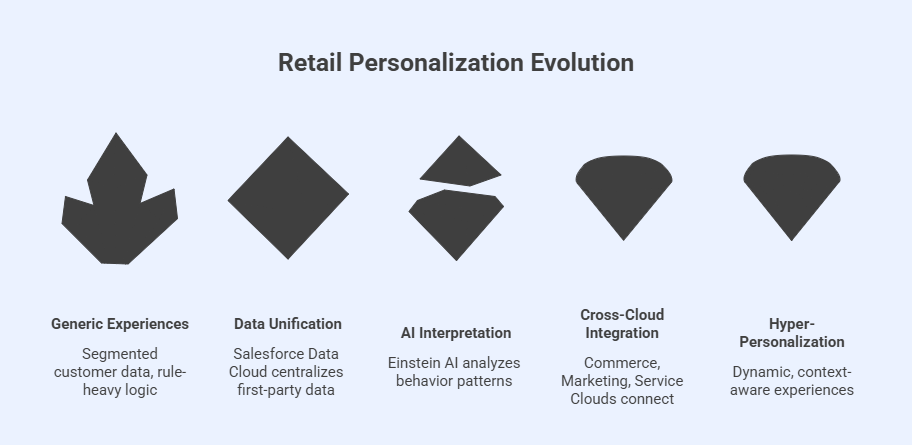
The benefits compound quickly. Retailers see higher conversion rates, improved inventory turnover, and stronger customer lifetime value because engagement feels timely and relevant. Operational teams gain clarity instead of complexity, since personalization logic is driven by unified data and AI recommendations rather than manual segmentation and duplicated workflows. Most importantly, trust improves—customers are more willing to share data when the value exchange is obvious.
Looking ahead to 2026, hyper-personalization will mature beyond marketing into a full experience ecosystem. AI-driven decisioning, predictive service, autonomous commerce flows, and real-time experience orchestration will define retail leaders. Salesforce’s roadmap aligns closely with this shift, focusing on scalable data foundations, responsible AI, and cross-cloud intelligence that grows with the business—not against it.
If you’re evaluating how Salesforce fits into your digital retail roadmap, we help organizations validate personalization strategy, design scalable architectures, and turn CRM investments into measurable, customer-centric outcomes.